Venus Superior Conjunction August 16, 2011
 Venus, the resplendent morning or evening star, outshines all the other planets and stars in the heavens. As its orbit is closer to the Sun than the Earth's, it can never stray very far from its source of luminosity. Its twinkling presence may grace either the eastern horizon in the pre-dawn sky, or the western horizon just after sunset; and is never seen during the night. At most it is visible for a few hours before disappearing into the radiance of the day or evening twilight. Thus Venus rules photography's magic hour when a special effect is captured due to the soft romantic quality of the light. The dazzling brightness of Venus is due to its thick clouds that reflect 70% of the Sun's light back into space, and to its close proximity to the Earth. From our perspective, Venus is the brightest planet in the entire solar system.
 Venus also has a unique orbit and rotation. The bright planet rotates in an opposite direction from all the other planets in the solar system, so the Sun rises in the west and sets in the east. A Venus day (243 earth days) is longer than its year (225 earth days). As it takes 243 earth days to make one rotation (day), its day makes an intriguing mathematical harmony with an earth year. A Venus day is 2/3 of an earth year, and because Venus makes a complete revolution around its 177.3 degree axis once every 2/3 of an earth year, it revolves exactly 12 times in an 8 year period. And the orbit and rotation of Venus are synchronized in such a manner that Venus always presents the same face to us when Earth and Venus are at their closest proximity during an inferior conjunction.
In addition, the mathematical harmonies of Venus' orbit and rotation in relation to the earth are even more astounding when you begin to understand its synodic cycle. Viewed from the earth, Venus' full synodic cycle (from inferior conjunction to inferior conjunction with the Sun) takes 584 days, or about 1.6 years. After nearly 8 years and 5 synodic cycles, Venus returns to its starting point drifting westward by about 2-3 degrees. The 5 successive inferior conjunction points that occur during its retrograde cycles trace a pentagram around the zodiac during this time, flavoring each conjunction and pentagram series with its own unique stellar influences. During the past 8 years the zodiac signs impacted by this fivefold pattern are: Taurus, Libra, Pisces, Leo, and Sagittarius (click here for dates of recent inferior conjunction dates). The 2-3 degree drift of the pentagram ticks through the whole zodiac in 1,215 years. It is intriguing that at this point in history two of the signs ruled by the benefic Venus, Taurus and Libra, make up two points of the pentagram. Maya scholars suggest that the Birth of Venus is linked with the creation of the Mayan Calendar, and as we shall see seems to be linked to its completion as well. The points of the pentagram in Sagittarius and Pisces are ruled by the great benefic Jupiter. And the fifth point in Leo is ruled by the Sun. All these signs are related to the growth of the soul or atma (Sun) through love (Venus) and wisdom (Jupiter). Perhaps Venus cycles can reveal to us the pathway to this discovery of our highest selves?
Venus and Phi, a Divine Proportion of Harmony
Curiously 8 earth years (8x365=2920) equals 13 Venus years (225x13=2925), two numbers that have an intriguing relationship. When combined with the 5 of its synodic cycles in 8 earth years with 12 Venusian days, a harmonious pattern emerges.
 These numbers are familiar to anyone who has played the piano or is familiar with music theory and the Fibonacci sequence. An octave (8) contains 12 white keys and 5 black keys comprising the chromatic scale. The 13th note begins the next octave. The orbital ratio of 13 Venus years to 8 earth years, 13:8, reflects the Fibonacci sequence and ratio that produces the number 1.625, very close to the golden ratio of phi (1.618033). Additionally Venus' synodic cycles also express another Fibonacci ratio: 8:5 as it takes 8 years to complete one 5-fold pattern. 8/5 equals 1.6, again close to phi. This “golden” number, 1.61803399, represented by the Greek letter phi, is known as the Golden Ratio, Golden Proportion, Golden Mean, Golden Section and Divine Proportion. The Golden Ratio is unique in its mathematical properties and pervasive in its appearance throughout nature.
The Fibonacci Series is a sequence of numbers that when the sum is added to the previous number, a formula correlating to growth and harmonic cycles develops-- for example 0, 0+1 = 1, 1+1=2, 2+1=3, 3+2=5, 5+3=8, 8+5=13 ect. When the sum is divided by the previous number the result is the golden ration, or phi (8/5 = 1.6 ~ 1.618). The phi ratio is found throughout the natural world, such as in the spiraling growth pattern of galaxies, plants, shells, cellular structures, breeding patterns and the helix structure of DNA. The video below beautifully illustrations these spiraling ratios.
When the phi ratio is applied to human constructs of music, art, and architecture, the resulting harmonious pattern is said to evoke an aesthetic and emotional reaction that is comforting to the soul as it draws on proportions found in nature. Phi was especially prized by Renaissance artists who sought to find and express the hidden divine order of the cosmo expressed in its mathematical formula. In astrology beauty, art, music, color, harmony in form, order and proportion are all attributes of Venus. The cycles of Venus literally embody harmony and beauty. The bright light of Venus imprints an energetic blueprint as it passes through the twilight skies transmitting a divine harmonious order of the heavens to the Earth.

Two Masks of Venus
Within each 584 day synodic cycle, there are two distinct phases of approximately 263 days which are separated by intervals when the bright planet is totally obscured from sight. The shortest period of darkness marks the beginning of the cycle when Venus is closest to Earth making an inferior conjunction to the Sun. After only 7-9 days of invisibility, Venus reappears dramatically, rising before the Sun in the east as the morning star.

Three weeks later Venus reaches maximum brilliancy (when it is 39 degrees from the Sun), then slowly decreases in light before disappearing a second time at the superior conjunction when she disappears for up to 60 days. The Greeks called the morning star phase Phosphoros meaning "Bringer of Light," or Eosphoros, "Bringer of Dawn.” The evening star phase was Hesperos meaning setting in the west.

The superior conjunction occurs when Venus is at its greatest distance from Earth and passes behind the Sun. During this interval, it is out of sight for almost 60 days. Venus reappears from this much longer period of darkness as an evening star in the west where she sets a little later each night while increasing in brilliance, until she turns retrograde and heads toward her next inferior conjunction with the Sun a month later.


Many ancient sky-watching cultures interpreted the periods of darkness when Venus disappears from view on the earth as a time when the goddess traveled to the the underworld. The ancient Babylonians called Venus the double-phased Ishtar -- the morning star of war and the evening star of love. As morning star Venus was often represented as a bearded warrior bearing weapons. However, as an evening star the archetype shifts and becomes softer, more attuned to reconciliation, treaties, bringing communication and cooperation to whatever she is uniting. Isn't it interesting that the time period for Venus to shift from its phase as morning star of war to evening star of love is longer than its transformation of evening star of love to morning star of war, by a factor of 10-12! It seems to take a lot more internal work in the underworld to bring out the love.

Some of the earliest references to Venus are found on clay tablets dating as early as 3000 BC from Uruk, an important early Sumerian city in southern Iraq. In ancient Sumer the goddess Inanna was associated with the planet Venus and the Uruk tablets specify her celestial identity as Venus with the symbol of an eight-pointed star.
 There are hymns dedicated to Inanna that describe as her astral manifestation of the planet Venus. It is also believed that the myths about Inanna correspond with the movements of the planet Venus in the sky. Inanna's Decent to the Underworld (click here) explains how Inanna is able to descend into the netherworld, pass through a series of tests, and return to the earth by ascending to the heavens. The planet Venus appears to make a similar descent, setting in the West and then rising again in the East. And during her journey to the underworld, the goddess Inanna passes through seven gates (chakras? weeks?) removing an article of clothing at each gate until she is completely naked exposing her bright beauty to the darkest realms. As my partner Joseph pointed out to me: The clothing represents the constructs of our ego and aspects of our false self. It only feels like Hell if we are attached to our egos. By removing her clothes Innana strips down to her bare essence and is given the opportunity to connects to her true self. In order to exit the underworld, Inanna was required to select someone to leave behind in her place. Could this be her shadow? When Innana returned to her kingdom, she finds that her husband Dammuzi had showed no concern for her during her absence. Thus she sent her "unconscious" male aspect, or animus, down to the underworld in her place where he is beaten and gashed with axes. Could the two faces of the Sumerian Venus and cycles of Venus represent the shamanic process of dissolving the ego, anima, and animus to release the divine enlightened self?
The Assyrian and Babylonian name for Inanna is "Ishtar" and may reflect the Sumerian origins of "Easter" and other resurrection themes. In fact, Jesus is also called the morning star:
I Jesus have sent mine angel to testify unto you these things in the churches. I am the root and the offspring of David, and the bright and morning star.Something similar may be behind the myth of Inanna/Ishtar's descent into the underworld and the Egyptian myth of Isis and Osiris. In ancient Egypt the planet Venus was called the star of the ship of the Bennu-Asar. Asar is the Egyptian name of Osiris, the Egyptian god of the underworld. The Bennu was a large imaginary bird similar to a heron that is commonly equated with the phoenix, the mythological bird of resurrection. Bennu also means "'the ascending one."
~ Revelation 22:16

The ankh, or key of life, frequently appears in Egyptian tomb paintings and other art, and is depicted grasped in the hands of a god or goddess of the afterlife, like Osiris. Perhaps it is no accident that the ankh is still used today as the symbol for Venus.

Isis was also associated with the planet Venus (Pliny the Elder), and her search throughout Egypt for her dead husband Osiris is likened to Inanna's descent. Thus the Egyptians may also have associated death and resurrection with the Venus' evening and morning appearances, or perhaps with its conjunctions behind the sun and its periods of visibility.
 Mesoamerican astrologers considered the first appearance of Venus morning star to be a dangerous time. The Dresden Codex is a pre-Columbian Maya book that dates to the 11-12th century Maya at Chichen Itza. It is believed to be a copy of an original text dating three or four hundred years earlier. There are six pages in the Dresden Codex that are devoted to the accurate calculation of the heliacal rising of Venus and thereby reveal that the morning star was at the heart of Maya calendars and cosmology. This page from the Dresden Codex serves as a combination of calendar and almanac and charts the significance of specific dates related to the movements of Venus. From evidence in The Dresden Codex, scholars believe that 1 Ahau was the traditional Sacred Day of Venus for the Maya which initiated the Venus Round. The Venus Round was a later calendar created to synchronize the Venus cycle with the Haab and Tzolkin calendars. One Venus Round = 104 Haab or 37,960 days ensuring that if Venus emerges as morning star on the Winter Solstice on the almanac day 1 Ahau, it will take 104 Haab for this to occur again.
 The so-called end of the Mayan Calendar, or The Long Count, completes at 13 Ahau, the end of the 13th baktun which is measured from the Birth of Venus. The basis of Calleman's argument for the October 28, 2011 date over the 2012 date is that the later date is out of sync ending at 4 Ahau, and his date does end on 13 Ahau. Ahau means "sun," "light," or "lord" and it seems fitting that astrologically the Sun is rising with Venus on Calleman's end date. (For more see my previous post on understanding the end dates of the Mayan Calendar.) I find this glyph of Ahau to be intriguing as it seems to represent the Sun emitting or being caught by a beam of light surrounded on either side with two dots, perhaps indicating the inner planets Mercury and Venus. Or could they represent the two phases of Venus that figure so prominently in Mayan lore. Ahau also is a day to ask for wisdom and to remember the ancestors thus linking it to a netherworld meme.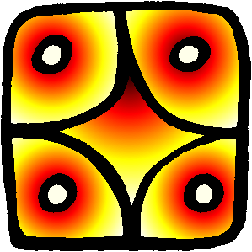
Lamat means "star" and is the Mayan glyph for Venus. Lamat is the we of community consciousness, and remembers as in group consciousness. Lamat likes to fight, but is always reaching to operate out of love -- sounds like the two phases of Venus! Both of these glyphs are two of the five Mayan South Suns: Kan, the seed, Lamat, the Venus Star, Eb the Human, Cib the Warrior, and Ahau the Solar Lord. According to Aluna Joy Yaxkin: "The suns of the south, especially Ahau, are idealistic and can ripen what has been started and raise it into full potential within the highest form of manifestation."
 Mesoamericans linked the morning phase of Venus with Quetzalcoatl. According to the Aztecs Quetzalcoatl was often considered the morning star, and his twin brother Xolotl was the evening star. The god Quetzalcoatl is depicted as the feathered serpent. Quetzacoatl was also known as Tlahuizcalpantecuhtli, meaning "lord of the star of the dawn." He was a god of the wind, priests, and knowledge. Quetzalcoatl is a primordial god of creation, a giver of life. After the last world, the Fourth Sun had been destroyed, Quetzalcoatl went to Mictlan, the land of the death, and created our current world, the Fifth Sun, by using his own blood, from a wound in his penis, to give new life to bones. Quetzalcoatl is also the giver of maize (corn) to mankind.
 Xolotl is a dog-like deity, often depicted with ragged ears. He is identified with sickness and physical deformity. As the twin of Quetzalcoatl, he carries his conch-like ehecailacacozcatl or wind jewel. Xolotl accompanied Quetzalcoatl to Mictlan, Land of the Death or the underworld, to retrieve the bones from those who inhabited the previous world to create new life for the present world. In a sense, this re-creation of life is reacted every night when Xolotl guides the sun through the underworld.
In ancient Mexico, Quetzalcoatl (in Mayan languages called Kukulcan or Gugumatz) represented the deity of light and duality and was seen as the creator of civilization. Legend also has it that he will return at the end of the 5th world. Thus, it has been suggested by many authors that the energies of Christ and Quetzalcoatl are the same, or at least closely associated. According to Carl Calleman:
"If nothing else, it was in the baktun ruled by Quetzalcoatl, AD 40-434, that Christianity expanded to a world religion. This, in contrast to many of the religions that had preceded it, brought a message of love and forgiveness to mankind. On a symbolic level the Cross of Christianity was an expropriation of the World Tree and Quetzalcoatl was really the Serpent that in so many traditions was winding around the World Tree and in this symbolism the two energies are immediately connected."Christians, Mayans, and Hindus all describe the return of the Morning Star as symbolic of the return of their teachers. Some believe that the Venus transit of 2012 marks the beginning of the end of a long, long, cycle.
Venus Transit
The current 8-year Venus cycle will culminate in a rare Venus transit in front of the Sun during the final leg of this eight year set during the last year of the 2012 Mayan Calendar. A transit of Venus across the Sun takes place when the planet Venus passes directly between the Sun and Earth, obscuring a small portion of the solar disk. It is similar in effect to an eclipse of the Sun by Venus, but instead of blocking all the solar light, Venus can be seen from Earth as a small black disk moving across the face of the Sun. Transits of Venus are among the rarest of predictable astronomical phenomena. They occur in a pattern that repeats every 243 years, with pairs of transits eight years apart separated by long gaps of 121.5 years and 105.5 years. The periodicity is a reflection of the fact that the orbital periods of Earth and Venus are close to 8:13 and 243:395 resonances.
2004 Transit of Venus
2012 Transit of Venus
After 2012, the next transits of Venus will be in December 2117 and December 2125.

The next transit of Venus will begin on June 5–June 6 in 2012 (a day after a partial lunar eclipse in Scorpio), succeeding the previous Venus transit in Taurus/Mrigrashira of June 8, 2004. During the transit of 2012 Venus will return to its own sign of Taurus, but this time will be a few degrees earlier in the nakshatra of Rohini. The star associated with Rohini is the great royal star Aldebaran, the "watcher of the east." The residing deity of Rohini is Prajapati, the Creator who grants our deepest desires. The power associated with this nakshatra is rohana shakti, growth -- as might be expressed in the Fibonacci sequence and phi. Rohini is also called the "star of ascent" giving an increase in status in society, and perhaps to our souls. This Venus Transit will herald a provocative shift in energy at that time in which we may be able to call upon the Creator for the gift of ascension, be it material or spiritual!
Venus Superior Conjunction August 16, 2011
The previous inferior conjunction of Venus occurred in its own sign of Libra at 11 degrees on October 28, 2010. As Venus retrograded away from the Sun, it reappeared a few days later in the morning sky in the nakshatra of Chitra shedding its love attire for warrior wear. Although Libra is ruled by Venus, the nakshatra Chitra is ruled by Mars, thus giving this morning star phase a very contentious energy. During the past 9 months we have certainly seen violence and unrest take center stage.
Currently Venus is still in the warrior morning star phase, but is about to make its superior conjunction on August 16, 2011 at a critical 29 degrees Cancer (conjoined a combust, sande, and retrograde Mercury). Cancer is a very nurturing sign as it is ruled by the Moon. It inspires Venus to give to others and be devotional and accommodating in relationship. However, Venus and the Moon belong to different planetary camps and have very different natures. The Moon is emotional and devotional. It expresses unconditional and selfless love like that of a mother. Venus is concerned with romantic and conditional love that requires diplomacy and boundaries to cultivate. When Venus comes under the Moon's influence it may become more emotional and unable to maintain good boundaries longing for an unconditional connection. Moreover, as Venus will be in the nakshatra of Ashlesha, the "entwining star, "we may become entangled and enmeshed in unhealthy relationships in which we are treated, or treat others, like children.
 A coiled snake is the primary symbolism of the nakshatra Ashlesha, and its name may be derived from the serpent king Shesha. Although the snake is feared in today's modern society, serpents were seen as wise and divine creatures with access to other worlds, like the nagas of India. The coiled snake also represents the kundalini energy resting at the base of the human spine, which rises when consciousness is awakened. Thus the higher function of this nakshatra gives insight, intuition, perception, wisdom and cunning to Venus during its 60-day shamanic journey to the underworld.
 However, Venus makes its superior conjunction while it's sande (end of a sign/29 degrees) and gandanta (the juncture between water and fire). Gandanta is traditionally described as an inauspicious position causing misery to the area of influence of the planet, in the case Venus the planet of diplomacy, the arts, and desire. As Venus will be both gandanta and combust, matters related to it may be adversely effected. Under the influence of the nakshatra Ashlesha, we may find ourselves entwined with others who are manipulative or toxic. The gift of Ashlesha is visasleshana shakti, the power to inflict with poisonous venom. I can't help but recall the myth of Orpheus and Eurydice who is bitten by a snake and dies, thus initiating Orpheus' journey to the underworld to rescue her. Orpheus used his venusian gift of music to pass by the gates of Hell, and garner sympathy and compassion through the sweet melachony tones of his lyre. Like Inanna his attempt to return to the upper world was conditional. He must not look back. But he did, and failed, losing his beloved Eurydice a second time until they were reunited after his own fateful death.
Snake venom can paralyze and kill its victim in minutes, but when used medicinally can cure illness. The question is how will Venus use this shamanic journey to the underworld, where snakes and death lay in wait? Perhaps during this phase of the last synodic cycle of this grand pentagram series, we might be able to do some shamanic work ourselves and look deep into our core to see what we need to discard and leave behind. Or might we bring back information from the other side that will bring love back into our lives? What issues, judgments, and unhealthy choices might be blocking our kundalini from freely rising and enlightening us? This fall promises to be a time for us to discover and heal these blockages. What doesn't kill us will certainly make us stronger.
I leave with the wise musings of Carl Calleman discussing the return of the divine feathered-serpent, Quetzalcoatl:
But then, how is Quetzalcoatl to return? Regardless of by what means, anyone who is able to connect to the Oneness of All at the time of the Celebration will become a living incarnation of Quetzalcoatl. To become real the energy of Quetzalcoatl must manifest in human beings. At this time this must happen through the absorption of the energy of light on the right brain and unifying this with the left. This is really about activating Kundalini energy for which humanity may now be ripe. A winding energy of light in our bodies, a manifestation of the movement of the serpent of light, Quetzalcoatl, may serve this purpose. This will set the road to wholeness in an otherwise turbulent time.
Namaste!
Update:
While I started to write this post last Tuesday, I finished it on Friday July 29, 2011, the same day that this crop circle was found in West Woodhay Down UK.

The synchronicity with the upcoming superior conjunction with Venus on August 16th in Ashlesha is mind-blowing! However it doesn't seem to include the planet Mercury in this configuration, which as I pointed out in my post of July 30th also makes its inferior conjunction at the same degree and time. . . wonder what that means? I would substitute Mercury for the earth in the diagram and then this makes extraordinary sense (at least to my abstract mind).
Addendum:
Just had to add this last bit of mathematical synchronicities between Phi and the I ching for you all to chew on too:
What if we combine the spiral unfolding of the Golden Proportion (PHI=1.618) with the exponential expansion of the I Ching (2,4,8,16,32,64)? This is what we get:
2 x PHI = 3.25 8 x PHI = 13 32 x PHI = 52
4 x PHI = 6.5 16 x PHI = 26 64 x PHI = 104
These are all the essential numbers of the Mayan Venus Round system!
From http://alignment2012.com/fap13.html