Thursday, March 3, 2011

An Astrological Glance at the Mayan Calendar


Unless you have been living under a rock, you probably have heard of the Mayan Calendar and the media hype about it coming to an end in 2012. Interest in the Mayan calendar and its so-called prophecies has increased at a phenomenal pace due to over-the-top catastrophe movies like 2012 and television series like The History Channel's Decoding the Past: Doomsday 2012. Our collective fear of an apocalypse has projected an ending to a calendar that according to most Mayan scholars actually tracks cycles of time and the evolution of consciousness. There is a lot of misinformation and wild interpretations concerning the meaning of the Mayan calendar.

Although I am by no means a Mayan Calendar scholar, I have been fascinated by the Maya since childhood. In 1976 my dear Aunt Phyllis (Tata) offered to take me any where in the world that I wished to go to celebrate my 13th birthday. I knew immediately where I wanted to go: to Mexico to see the Mayan ruins. I chose a Smithsonian tour of the Aztec city of Teotihuacan and Mayan cities of Palenque, Uxmal, and Chichen Itza in the Yucatan peninsula. No doubt I was influenced by articles on the exciting archaeological discoveries described in National Geographic and Smithsonian magazines which stirred curiosity in my young receptive mind.


In particular, I was fascinated with the sudden and mysterious "disappearance" of the Maya, as well as with their undecipherable glyphs described in the literature of the day, such as Michael Coe's classic The Maya (1966) and T. Patrick Culbert's Lost Civilization: Story of the Classic Maya (1974). And the Dresden Codex had just been published in a color catalog which I spent hours studying and wondering what the mysterious glyphs and images conveyed. I felt energetically connected to this magical world, and during my tour of the Yucatan I had a mystical experience in which I felt I could fly should I have tried to jump off the edge of a Mayan temple -- many years before I would learn about the psychedelic experiences of Terrence McKenna. Thus began my lifelong fascination with the Maya.

The Dresden Codex is a pre-Columbian book of the eleventh or twelfth century Maya of Chichen Itza. It was written by eight different scribes using both sides of the paper made from Amatl, fig-bark that has been flattened and covered with a lime paste. Each scribe had a unique writing style, glyphs, and subject matter. The codex totals 74 pages in length. Its images were painted with extraordinary clarity and contain astronomical tables of outstanding accuracy. It is most famous for its Venus tables and lunar series that has intervals correlating with eclipses. In addition the codex also seems to show conjunctions of constellations, planets, and the Moon. As a Vedic astrologer I am still amazed at the mathematical accuracy of Mayan astronomical tables for Venus and eclipse patterns.

But this astronomical data was not used by the Maya in the same way as we might use it today. The solar cycle was not a reflection of their consciousness as it is in our culture. Instead the Maya used the Tzolkin, a 260 day Sacred Calendar that measured the most basic rhythm of the cosmos that had been given to them by the gods. Unlike other solar or luni-solar calendars, the Tzolkin tracks waves or cycles of growth that are not necessarily linked to the fixed stars of the zodiac. Perhaps this is why some astrologers believe that astrological charts of the Mayan end date do not seem to reveal any big planetary line-ups or astronomical event that might signal the so-called end of an age or shift in the evolution of consciousness. (And what would the "end of time" look like in an astrological chart anyway?) As we shall see there are no mind-blowing alignments like the planetary line up on the 2010 Winter Solstice, but rather symbolic inklings of a potential cosmic shift, and perhaps a gift of immortality released from celestial waters by the gods.

2012 and Galactic Alignment
Part of the confusion around the Mayan Calendar is that there are three different dating systems that were used simultaneously by the Maya: the Long Count, the Tzolkin, and the Haab. The Long Count (360 days) measured long periods of time, the Tzolkin (260 days) measured sacred time, and the Haab (365 days) measured civil time. All three calendars were based on the vigesimal (20)mathematical system and are harmonics of each other that interact like cogs in a great harmonious cosmic clock.


Although the Maya did use a 365-day solar calendar called the Haab for practical and agricultural reasons, the 260-day Tzolkin was preferred for ceremonial and ritualistic purposes. Unlike many other cultures who depended on a luni-solar calendar to schedule ritual, the Maya seemed tuned into another cyclical force. However, the first calendar, called The Long Count was used for looking back in time and for recording events over long cycles or World Ages which does suggest that the Maya did use astronomical observations in development of this calendar. The end date of the Mayan Calendar is the completion of the Fifth World Age of the Long Count that began on August 13, 3113 BC. Each world age is approximately 5,125 years long and adds up to 26,000 years, or the Great Year based on the cycle of precession.


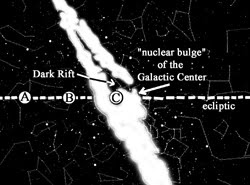
Author John Major Jenkins is credited with being the first independent Mayan researcher to suggest that the Mayan Calendar marks an astronomical alignment of the Winter solstice Sun with the great rift in the Galactic Center. This alignment occurs every 26,000 years result of the precession of the equinoxes. Drawing from his own groundbreaking research and more than two decades of extensive study of Mayan culture, Jenkins suggests that the Maya based their calendar on observations of the Great Rift, a band of dark dust clouds in the Milky Way, which the Maya called the Xibalba or Black Road.

In Galactic Alignment Jenkins describes how the symbolism and iconography embedded in the temples and monuments at Izapa, the site where the Mayan Long Count Calendar was created, depict creation stories that prove the Maya were aware of where the ecliptic intersected the Black Road and gave this position in the sky a special significance in their cosmology. According to Jenkin's hypothesis, the Sun precisely aligns with this intersection point at the winter solstice of 2012, which he believes the classical Mayans anticipated as the end-of-a-World Age signal that heralds a spiritual transition for mankind.


When Jenkins compared the Mayan calendar with other ancient traditions that were aware of the precession cycle, including Hindu, Egyptian,and Persian astrological sources, he began to understand what all the seers of ancient cultures knew: that during this galactic alignment humanity aligns itself with the higher frequencies of the galaxy and thereby moves humanity into a higher octave, or dimension, or way of being. Just as the ancient seers of the Vedic culture saw the astronomical alignments with the galactic center, or Vishnunabhi, as marking the ascending and descending yuga cycles, so did the Maya perceive an energetic alignment with Xibalba or Hunab Ku. To the Mayans Hunab Ku was the "one" supreme God and ultimate Creator whose essence was located in the center of the Milky Way galaxy. Other Mayan researchers such as Jose Arquelles describe Hunab Ku as a gateway (perhaps a black hole) to other galaxies beyond our Sun, as well as all of the consciousness that has ever existed in this, our own galaxy.


If the Mayan calendar is a marker for an astronomical alignment that precipitates a shift in consciousness or opening of a gateway, then we might expect to find some astrological indicators for this grand cosmic event. So I think it might be a useful exercise to explore the astrological implications of certain key dates of the Mayan Calendar to see what themes arise that may help us understand the nature of this shift. Although comparing the Mayan Calendar with Vedic Astrology is like comparing apples and oranges, we still may be able to squeeze out some juicy insights from examining the event charts for the end date of the Mayan Calendar December 21, 2012.

December 21, 2012 11:11 UT (in London for location with 11:11 UT)

Strangely the Winter Solstice of 2012 occurs at 11:11 universal time. 11:11 has been a number associated with synchronicity, gateways, and ascension. It is believed that these master numbers trigger an unconscious knowledge of a coming shift of consciousness. Whether the Mayan truly knew the exact time of this particular Winter solstice is doubtful, but they may have understood it in terms of cycles and alignments of the Milky Way with the Sun. The Vedic chart for December 21, 2012 at 11:11 UT continues the numerological synchroncity with the 11th sign of Aquarius is rising on the horizon at 8 degrees in the nakshatra Shatabhisha.


(On a personal note, it is an intriguing synchronicity that I write this post under the influence of a new moon in Shatabhisha conjunct Mercury and Mars, all of which are transiting my Shatabhisha ascendant.)


The fixed sign of Aquarius is represented by the Water-Bearer, or "physician of the gods," pouring the sacred pot of soma, the divine nectar of immortality upon humanity. The nakshatra Shatabhisha literally means "the one hundred healers" and its gift of bheshaja shakti, the power of healing, is generated by Varuna, the god of rain and cosmic waters. The acupuncture point Baihui means one hundred points and is used to open the crown chakra, which has a thousand petals. This chakra is associated with divine wisdom, our Unity with the Universe and all that is. Its blossoming is a sign of awakening and enlightenment. What a marvelous rising sign for an event chart of prophesized Awakening and Ascension.

Varuna is an ancient Hindu deity who governs over the change of seasons, divine law, and healing. Varuna means "he who covers" and probably refers to his rulership of the skies and cosmic weather. From this elevated position of observation it was natural for a deity like Varuna to become the great observer of deeds; and his role was to punish those whose transgressions were of not merely the Law, but Rta, Cosmic Order. How appropriate for a shift in consciousness to be nourished by the celestial waters and facilitated by the keeper of seasonal change and governor of divine order, Varuna.

Pre-Vedic legend describes Varuna as one of the Adityas, the children of the Earth mother Aditi. These solar deities reside in the heavens and personify various natural phenomenon. Varuna is lord of the oceans and water element in nature. Some neo-Vedic astrologers equate Varuna with the Grego-Roman god Neptune, who in modern astrology rules Pisces and the planet of divine inspiration and psychic sensitivity, Neptune. Synchronistically Neptune will also be rising on the horizon in Shatabhisha during the 2012 Winter solstice. Like his ancient Roman counterpart, Varuna is depicted as a fair complexioned god riding a sea monster while holding a pot that contains soma, the magical elixir of the gods that gives rejuvenation, intoxication, and immortality.


As the god of rain, Varuna presides over the oceans and the skies. He is associated with the dark half of the sky as he carries the sun deep below the waves over night. In addition to fearful predictions of world wide flooding with the earth changes associated with the Mayan Calendar and 2012, other prophecies by the Hopi Indians foretell that the Sun will darken and night will last for three days: there will be three days of emptiness and darkness. Will Varuna hold the Sun below the waves for three days in 2012?

Another interesting theme related to catastrophic flooding is that Varuna is also a god of the dead and keeper of drowned souls, who grants immortality to those in live in accordance with divine law by sharing the precious elixir of immortality called soma. The connection to immortality is depicted in the symbol for Shatabhisha, an empty circle. The significance of the circle refers to cycles of all kinds: the cycle of life and death, the cycle of day and night, or a trip around the zodiac. When you look these cyclic pattern of energy, you realize that there is no death, only eternal cycles. Perhaps this is the secret to immortality? Or perhaps we awaken and remember that we are eternal at the end of a Great Year?


Saturn is the ruling planet for an Aquarius ascendant, and it will be transiting its sign of exaltation, Libra in the nakshatra of Swati on the Winter Solstice of 2012. Although Saturn is traditionally viewed as the legendary king of malefics and lord of time, karma and consequences, he is a benefic for an Aquarius ascendant, especially when placed in its sign of exaltation in the 9th house of dharma, law, and spirituality. The 9th house gives grace and good fortune. Might divine law once again be manifest upon the Earth in an act of cosmic grace? How might Saturn, the planet that is a significator of all in life that is bound with the chains of time, come to destroy time itself? According to David Frawley:

Our great fear of Saturn has measured the degree of our attachment to the material world and our inability to face the ultimate issues of our existence. Saturn shows us the limitation of this realm, which is the necessary but painful lesson we must learn to find our way back into the unlimited. Saturn is death that takes us beyond the limitations of mortal life, which is the gateway to the eternal, though straight and narrow as the razor's edge.


Saturn will be transiting the nakshatra Swati which translates as: "self-going", "good goer", "self-blowing", "tender", "sword" or "priest". These terms seem to encompass all the qualities that this asterism evokes. Its symbol is a single plant shoot blown by the wind. Swati is ruled by Vayu, the demigod of air and wind. In Hinduism he is also known as Vata (air), Pavana (purifier), or Prana (breath). Astrologically air and wind symbolism reveals the quality that confers its restless nature. This nakshatra gives the power to "scatter like the wind," pradhvamsa shakti. Thus it seems Saturn may bring change through the element of wind, perhaps combined with the cosmic waters of Shatabhisha.


Both Shatabhisha and Swati are ruled by Rahu, the north node of the moon, that has a vata, literally "blown", or airy, nature. Rahu is a manifesting force that can build like a gentle breeze, or wreak havoc and blow like a category five hurricane. Moreover Rahu is legendary for inspiring fear as its shadow is powerful enough to consume the luminaries during an eclipse. Rahu's mythic quest for immortality goes back to the Samudra manthan, the churning of the oceans at the beginning of time. In many ways Rahu is also connected to the manifestation of soma and promises an artificial immortality on earth, usually through fame and infamy, but perhaps in this case it is indicating more?

Rahu's placement in an astrological chart defines the area where new growth will take place in life -- our destiny. On the Winter Solstice of 2012 Rahu will be placed in Scorpio in the 10th house of karma at the transitional degree of 0 in the 16th nakshatra Vishakha, the "star of purpose." This is a very powerful place for the North Node. The nakshatra Vishakha spreads across the two constellations of Libra and Scorpio and is thus called 'two branched' or 'forked.' Thus is often depicted as a large tree with forked and sprawling branches that provide protection and produces fruit as it ripens with age. This celestial Tree of Life represents the process of reaching and attaining one's goals. The ancient Maya also believed in a Tree of Life that was connected to Hunab Ku, the creative center of the Universe in Mayan cosmology.


Mayan researcher Carl Calleman writes: the Mayan calendar provides a description of the rhythms of creative energies emanating from this hypothetical Tree of Life and is testable to what extent the actual rhythms of evolution conform to the time plan that this calendar specifies. Just as the ancient seers of the Vedic culture saw the astronomical alignments with the galactic center, or Vishnunabhi, as marking the ascending and descending yuga cycles, so did the Maya see an energetic alignment with the world tree that brought new life and growth.

There are two other symbols for Vishakha that are also quite intriguing: the triumphal gate adorned with leaves and a potter's wheel. A gate is structure that can be swung or drawn that reveals an opening which may be an entrance or an exit. Could this gate imagery associated with the nakshatra rulers of the lagna and lagna lord of the 2012 chart suggest that an energetic doorway may open on the Winter Solstice for us to triumphantly pass though? According to some interpretations Vishakha's triumphal gate comes not only with a celebration of success, but also with a promise of challenge. It symbolizes an ending in its attainment of a goal and the beginning of a new one. Like the eternal cycles of the Mayan Calendar, each end marks the beginning. Some New Age writers have suggested that the sudden disappearance of the Mayan culture was due to their departure through such a portal or star gate. Could this happen on a grand scale? Will a door open? Will you walk through it?

The third image for Vishakha is a potters wheel which symbolizes creativity and the cycles of time needed to build it. The Bible is full of references to the potter and clay. God created or prepared the earth, the clay, before he formed man, and out of it Man was made:

And the LORD God formed man of the dust of the ground. Genesis 2:7.

We are the clay, and thou are Potter; and we all are the work of thy hand. Isaiah 64:8b


As the great cosmic potter spins its wheel, our entire galaxy and universe spin with it. Could creative forces be ready to spin a new type of man, made not out of clay but out of wind and light? Is December 21, 2012 the birthday of homo luminous as many modern writers believe? Alberto Villoldo, PhD is a psychologist and anthropologist who has studied the shamanic healing practices of the Amazon and Inka shamans for over 25 years. In his book The Four Insights he writes:

According to the prophecies of the Maya, the Hopi and the Inka, we're at a turning point in human history, a period of great turmoil and upheaval in which a new species of human will give birth to itself. We're going to take a quantum leap into what we are becoming, moving from Homo sapiens to Homo luminous – that is, beings with the ability to perceive the vibration and light that make up the physical world at a much higher level.


As I was researching this concept of homo luminous for this post, I came across an article by Dr. Villoldo at Reality Sandwich. When I saw the image of this shining doorway, my heart skipped a beat. This synchronistic find assured my intuitive mind that my interpretation of the end date of the Mayan calendar is on the right track.


Could the Mayan Calendar actually be pointing to this evolutionary transformation of man into a being of light? If the end date of December 21, 2012 is correct, the planets, signs and nakshatras all seem to indicate that that a portal or star gate will be opening for us to celebrate a triumphant passage. While we can't know exactly what will happen, one thing is sure: change is coming and I for one, with a Shatabhisha ascendant, am ready to embrace the light.

Namaste!


To be continued. . .

Thursday, January 13, 2011

Astrological Identity Crisis

Zodiacal Change and the Revelation of the Precession of the Equinoxes

This ancient people whom we so contemn as our inferiors,...
Knew the precise position of the sun in utter space ere Britain's name begun:
Marked by precession of the equinoxes,
Three thousand years ere those first Christmas boxes
Were brought to Bethlehem by their kindred Magi;...


~ The Friend in The Age by Philip James Bailey


Capricorn: Jan. 20-Feb. 16.
Aquarius: Feb. 16-March 11.
Pisces: March 11-April 18.
Aries: April 18-May 13.
Taurus: May 13-June 21.
Gemini: June 21-July 20.
Cancer: July 20-Aug. 10.
Leo: Aug. 10-Sept. 16.
Virgo: Sept. 16-Oct. 30.
Libra: Oct. 30-Nov. 23.
Scorpio: Nov. 23-29.
Ophiuchus: Nov. 29-Dec. 17. (Yep, this one is new)
Sagittarius: Dec. 17-Jan. 20.

Today the media is filled with headlines concerning new dates for the signs of the Zodiac like the one posted by Time Newsfeed above. Online articles on Yahoo, MSNBC, The Huffington Post and Time posted headlines like Earth’s ‘wobble’ means your zodiac sign may be wrong which created quite a stir. In the commentary on many of these sites questions like "did your sign change" inspired confused discourse and adamant aversion to relinquishing their Sun signs. The fixed signs seemed to have the most difficulty. Those Leos just are NOT Cancers.

This astrological identity crisis is not new to Vedic astrologers who already use a sidereal zodiac, and have accurately charted the astronomical position of stars for thousands of years. The sidereal zodiac is astronomically accurate, whereas the tropical zodiac is based on seasons and equinox patterns. Both work in their own ways. In India astrology is called jyotish, meaning science of light. Thus tracking the light of the stars is at the basis of Vedic astrology. Jyotish is an ancient system that is part of the same spiritual and scientific traditions as yoga and ayurveda. In Vedic astrology the sign in which one's natal Sun is located at birth is not nearly as important as the Moon sign. Is is interesting how so many Westerners are emotionally attached to their Sun sign, which is only one aspect of the soul/spirit, and does not reveal the complete energetic image of the person like the entire astrological chart.

In addition, on this 13th day of January, the same story announce a "new" zodiacal constellation, Ophiuchus, which no doubt upset a few Scorpios and Sagittarians who fall in those zodiacal degrees. The 13th sign is called Ophiuchus, the "serpent bearer." Time posted this drawing of the 13th constellation and even presented its mythology to update and calm the folks under this sign.


It all started with this article written by Bill Ward of the Minneapolis Star Tribune (irony is ridiculous). He suggested that the stars might not be aligned in your favor due to a wobble of the earth that has messed up astrological alignments. It described the astronomical inaccuracies of astrological signs, but there was no mention of the mysterious 13th sign in that first report.

Writers at the online media site io-9 got in touch with the astronomer quoted in the article, Parke Kunkle, and asked him what he actually told the Star-Tribune.

He said he was asked by the Star-Tribune to give them a few bits of information about astronomy, not realizing the article would become a huge discussion of astrology and the relationship between astronomy and astrology. And the main stuff he talked to the Star-Tribune about has to do with the phenomenon of "precession."

And no, Parke Kunkle didn't tell the Star-Tribune that the zodiac ought to include 13 signs instead of 12 — especially since he doesn't believe in astrology at all. He did mention that astronomers tend to reckon the sun's position with 13 constellations instead of 12, and Ophiuchus is the 13th. But in the current astrology zodiac, there are just 12. "I just mentioned that it's there, and astronomers actually count it... So if you actually watch the stars in the background of the sun, it actually does go through the constellation of Ophiuchus." He adds that the Babylonians probably had totally different constellations anyway.


Wow, this so-called 'scientist' revealed his ignorance on the subject of astro-archaeology as well as bigger concepts in astronomy. The constellations have not changed, but our position to them has; and it does so in a very regular way that ancient sky watchers understood and recorded. But what he has inadvertently done is introduce the idea of precession of the equinoxes to the masses. This is not new information, so why is it suddenly 'news,'why now? Perhaps because precession is the core phenomenon tracked by ancient people to predict the shift of world ages as described in the traditions of the Vedas and 2012 Mayan calendar. It will be interesting to see how people digest this information. Once they get past their astrological identity crisis, perhaps they will actually want to understand the starry skies above and how they measure time and the evolution of consciousness.

For more on precession of the equinoxes check out this video.


The media's announcement and (re)introduction of a so-called 13th sign, Ophiuchus, is also intriguing. The 13th constellation is also described as the "eldest" sign both Western and Vedic traditions. In Vedic astrology Ophiuchus corresponds with the asterism or nakshatra Jyeshta, which contains three stars that the ancient seers envisioned as an umbrella or earring.


Jyeshta means "the eldest" or the "most senior." Some scholars suggest that originally there were only 18 nakshtras with Jyeshta designating the last lunar mansion. I believe it may also have a deeper astronomical reference. It aligns with the mass of dark dust clouds that mark the entry to the oldest part of our galaxy, the galactic center, though the Great Rift of the Milky Way. To the naked eye, the Great Rift appears as a dark road or passage into the the bright band of the Milky Way. The Mayan Calendar ends its current cycle or world Age when the winter solstice Sun enters the great rift in 2012.


What happens at that time, or is currently happening as some believe, is a shift of World Ages. Some believe a wave of interstellar energy will engulf the Sun and our Earth in waves of evolutionary energy.


The Mayans were not alone in watching this part of the night sky. The 17th Century astronomer Johannes Kepler depicted an allegorical and astronomical Ophiuchus in the drawing posted below.


Kepler was fascinated by Ophiuchus because it exploded during his lifetime. In fact it was the last visible supernova called Supernova 1604, or Kepler's Star. Like the Star of Bethlehem, this Supernova no doubt caused quite a stir as it was a visible and bright disturbance in the skies. First observed on October 9, 1604 Kepler's Star was brighter at its peak than any other star in the night sky -- and all the planets other than Venus -- with apparent magnitude 2.5.

Moreover, Supernova 1604 was visible during the day for over three weeks at the end of the 12 baktun, and beginning of the last and 13th baktun of the Mayan Calendar which we all know resets at the ends of 2012. There have been no observable supernova in the Milky Way since that time. Now that we are approaching the end of the 13th baktun, perhaps history will repeat itself and another galactic wave message might be sent from this area of space?

Although I'm thrilled that people are awakening to the idea of precession, I am disheartened that not one article mentioned the astronomical accuracy of Vedic astrology. Instead they used it as another opportunity to make snarky comments about astrology like Kunkle's:

There is no physical connection between constellations and personality traits, said Kunkle, who teaches astronomy at Minneapolis Community and Technical College. "Sure, we can connect harvest to the stars," he said. "But personality? No."


So in the unending battle to fight ignorance and bring light, I am re-posting an article called Twenty-Three on the differences between Vedic Astrology and Western Astrology. May the stars inspire you. If you pay attention you may even hear them whisper.


Twenty-Three

Twenty-three is my quick answer to the question: "what is the difference between Vedic Astrology and Western astrology?" I don't mean to be cryptic, but 23 degrees is literally the difference between the Tropical and Sidereal zodiacs. It is called the Ayanamsha -- in Sanskrit ayana meaning solstice and amsha meaning portion -- and it refers to the difference between Tropical and Sidereal zodiacs.

The zodiac is a ring of constellations often referred to as signs, such as Aquarius, Leo, Scorpio and Taurus. It is a cosmic clock around which our solar systems operates and how astrologers measure cycles of time. Most people do not realize that there are two distinct zodiacs. Vedic astrologers use the Sidereal zodiac and Western astrologers use the Tropical zodiac. The Sidereal zodiac is based on observations of planets lining up against the backdrop of the fixed stars. It is oriented to the center of the galaxy. On the other hand, the Tropical zodiac is based on the relationship between the sun and earth. It is oriented to the equinoxes. In Western astrology the spring equinox sets the beginning of the Tropical zodiac at 1 degree Aries, even though the sun is astronomically traveling in the light fields of Pisces. In other words, it does not correspond to observable position. Vedic astrology is called Jyotisha in Sanskrit, meaning the science of light, and Vedic astrology describes how the light emitted from the stars effects us. When Western astrology was in its early stages, the two zodiacs may have lined up; but over time the two moved apart approximately 50 seconds per year to the current 23 degrees of separation (even that number is debated, but the standard of India, the Lahiri ayanamsha is 23 degrees 10 seconds).

Vedic astrology is considered by scholars to pre-date Western astrology and is the only system that has accounted for the precession of the equinoxes. What is the precession of the equinoxes? The answer to that involves another occurrence of the number 23 (those familiar with the enigma of 23, like LOST and RAW fans, may find this amusing). Because Earth's axis is tilted 23° 27' in its orbit around the sun, its equatorial plane is tilted with respect to the ecliptic plane, the plane created by Earth's orbit. These two intersecting planes create an intersecting line called the vernal axis that occurs on the first day of spring, or Vernal equinox. As the Earth spins on its axis, its axis wobbles (precesses 50.3 seconds of arc per year or 1 degree every 71.6 years) very slowly over a period of about 24,000 to 26,000 years. As this occurs, the pole of the Earth inscribes an arc in the heavens called the precessional arc. The Earth's pole aligns with different stars throughout the precessional period. The current pole star is Polaris. Approximately 13,000 year ago it was Vega, one of my favorite stars. Earth's precessional cycle is also referred to as Earth's Great Year in the alchemical tradition, World Ages, or Yugas in the Vedas. David Frawley describes it a one year in the life of humanity.

In Vedic astrology there is a line of thought that suggests this 24,000-26,000 cycle (and even wobble of the earth itself) maybe be generated by a grand cycle of our sun with a companion dark star. Modern astronomy is studying this possibility as well. The ancient Vedic seers divided up the cycle into four world ages: the Satya(Truth or Golden), Treta (Third or Silver), Dwapara (Third or Bronze) and Kali (first or Iron) Ages. Each age describes a stage of awareness for mankind in which consciousness ascends, descends, and ascends in unending cycles perhaps due to the influence of this yet to be discovered companion star. Although New Age philosophers have described humanity as entering the Age of Aquarius, astronomically speaking that will not happen for approximately 300-400 years.


According to Vedic thought, the cycles of ascending and descending consciousness are connected not only to our rotation around a companion star, but also our cycle around the galactic center. According to Vedic astrologer and scholar David Frawley, "Vedic astrology orients the zodiac to the galactic center, or the central galactic sun, whose influence comes to us through fixed stars of the constellation Sagittarius." The galactic center is like our cosmic belly button -- it is sometimes called Vishnunabhi, or the navel of Vishnu-- the point from which our galaxy grew and expanded. Many ancient cultures studied and recorded their observations about this area of the night sky, including the Mayans whose calendar marks an astronomical event of our winter solstice aligning with the galactic center in 2012. It's like the earth's pole or antenna will be aligned and open to receive message from the source itself. [H]ohm is calling.

One of the most brilliant developments of the ancient Vedic seers was to further divide the zodiac into more identifiable parts. They did this by creating the Nakshatra system. In Sanskrit Nakshatra means lunar mansion. As the moon travels through the entire zodiac in 27-28 days, the ancient seers ascribed a Nakshatra for each day simplifying its location. Although too vast a subject to go into in this post, it is interesting to point out that the name for the Nakstratra that marks the galactic center is Mula, meaning root or source.

Another difference between Western and Vedic astrology is the modern use of non-observable planets and asteroids. As a Neo-Vedic astrologer I do consider some of the outer planets when I look at a chart, but I tend to be more interested in the fixed stars and Nakshatras. I marvel at how Western astrologers bring in new astronomical discoveries to their chart interpretations. Basically I see Western charts as a map of the same terrain as a Vedic chart, but indicating different types or levels of information. It's like comparing a topological map with a road map. I don't need to know the difference of elevation between Broadway and 3rd Avenue, but I might like to know the street number of Benaroya Hall. It all depends on what type of information one is seeking. Vedic astrologers come from a tradition and philosophy that focuses on the four aims of life: dharma (purpose), arthra (attainment), kama (desire),and the most important moksha (liberation). Western astrology is enriched by many diverse traditions and the information gleaned from it may be quite extensive and more suited for the modern mind. But for me, I've always been drawn to the stars in the night sky and have felt them speak to me in the language of light. And as Jyotisha is the science of light, it is the tool and filter I use to translate this information.

Monday, January 3, 2011

Astroweather -- Solar Eclipse

Bring me my Bow of burning gold; bring me my arrows of desire. ~ William Blake

New Moon, Partial Solar Eclipse January 4, 2011 at 1:03 am pst

As I have been discussing in previous posts, the end of 2010 brought an unprecedented lunar eclipse aligned with the galactic center on the Winter Solstice. The next phase of this eclipse period is the New Moon Solar Eclipse on Tuesday, January 4, 2011 at 1:03 am pst in the sign of Sagittarius.


During this solar eclipse both the Sun and Moon fall in the 20th nakshatra of Purva Ashada. This nakshatra contains two stars, Kaus Borealis and Kaus Australis, that form the archer's bow of the Sagittarius constellation. In mythology the bow is universally the weapon of both royalty and the warrior, often combined in the warrior-king, linking war and the chase. For example, in the Bhagavad Gita, the bow is Arjuna’s weapon, an emblem of kingship. Arrows represent messages, and the bow is the tool of the messenger. The warrior whose heart is pure will hit the mark. When Blake describes the Archer taking up the "bow of burning solar gold" he is describing the magical weapon through which he will express the ardent desire of his heart with the arrows of intent.


Sagittarius is a sign associated with shooting for far-off goals. It is also associated with seekers. In Latin Sagittarius derives from sagire, meaning to seek, or to know. The great benefic Jupiter rules the sign of Sagittarius and confers blessings and spiritual wisdom to planets transiting this area of the night sky. The ruling planet of the nakshatra Purva Ashada is the other great benefic Venus, which gives desire, popularity, and fame. Purva Ashada means "the undefeated" and is called the "invincible star" reflecting this combination of Jupiter and Venus influences. At the time of the eclipse Jupiter in Pisces will trine Venus in Scorpio which is a beautiful and auspicious aspect that will allow us all to take up our bow and take aim at our most heart-felt goals.

The deity associated with Purva Ashada is Apas, literally God in the form of water. The shakti gift associated with Purva Ashada is called varchograhana shakti, the power of invigoration. As David Frawley writes: Purvashadha brings about purification and regeneration, like the energy gained through taking a bath in water. It provides us additional energy for our efforts. These effects flow from the Waters, which in this instance are heavenly in nature and can provide inner purification.


Another deity associated with Purva Ashada is Varuna, the protector of the seas and giver of rain. Like water, he pervades all things. Water is the elemental source of life on this planet. The body is made up of 60% water, and our brains 85%. Thus the elemental aspect of the divine resides inside our very molecular structure. Moreover, the profound and provocative research of Masuru Emoto has reveal that water is also a messenger medium.


If a message is negative, it destroys the structure of water molecules. If positive, it creates highly organized and beautiful structure. Moreover, just as the power of the moon to move tidal water is heightened by the influence of the nodes during eclipse periods, our power to express our message (shoot the arrow) is also amplified. Whether this is for good or bad depends on the quality of our thoughts and intentions.

So although this eclipse has a lot of positive energy with the benefics in water signs, the line up of malefic planets, Sun, Mars, and especially Rahu in fire signs may combine to bring a steamy upheaval, especially geologically. Already during this eclipse period we have seen increased volcanic activity in the pacific ring of fire (where fire and water meet), torrential rains and flooding in Australia, and strong and increased earthquake activity across the world. This is a Rahu eclipse, and during the past week the children of Rahu, sunspots, have been increasing and releasing energy from the Sun which also has a profound effect on earth weather and geology.


I would not be surprised to see more activity during the next week, especially with Mercury traveling through its gandanta and sande degrees (see previous posts on its direct and retrograde stations).


This solar eclipse is the first of four partial solar eclipses occurring in 2011. The last solar eclipse of 2010 was a spectacular full solar eclipse that fell in the 7th nakshatra of Punavasu. As I described in the July 2010 post, the nakshatra Punarvasu consists of two bright stars, Castor and Pollux, above the constellation of Orion. Many ancient cultures saw these stars as twins or lovers, but ancient Vedic seers interpreted them as a "quiver of arrows. And these are no ordinary arrows. Punar means "to repeat" or to "return" and these arrows function like boomerangs, or divine astras, that magically return after fulfilling their function or mission. Their perigee is the moment they hit their target, but that is not the end as the arrow must bring its rewards by returning. Under that eclipse the release of our magical arrows set the stage, for this upcoming eclipse. We have an opportunity again to take up our bow, collect these arrows, and take new aim. This is the final eclipse that occurs fully in the Sagittarius-Gemini axis, which is also the current solstice axis aligned with the galactic plane. Use the purifying power of Purva Ashada to clear your heart, refine your goals, and release your magic to the Galaxy!

Namaste!

Saturday, January 1, 2011

Astroweather -- January 2011

Happy New Year 2011!

2011 begins with a waning Moon in Scorpio, its sign of debilitation. Under the influence of this emotional Moon, New Years celebrations may have been volatile as issues of anger, control,and jealousy may have bubbled to the surface. Or the bubbly might have triggered relationship drama, or unexpected and impulsive intimacy. However, quiet moments of deep reflection may have been more powerful than expected. It was a great night to reflect and perform ritual. Scorpio is ruled by Mars which gives courage, drive and great devotion to the Moon, especially in the 17th nakshatra of Anuradha. The symbol of this nakshatra is the lotus flower.


Just as the roots of a lotus are buried in the mud, they must grow and push the stem up through the water, in order to release the delicately scented flower above the water to bask in the sunlight. This pattern of growth signifies the progress of the soul from the primeval mud of materialism, through the waters of experience, and into the bright sunshine of enlightenment. Thus Anuradha promises to bring the flowering of consciousness out of the challenges of the murky material world.

Anuradha is comprised of a group of stars that resembles a staff or row of offerings to the Gods. Symbolism of the staff dates all the way back to ancient times in which a staff was used by shepherds to guide their flock. It is a symbol of authority and in some cultures of travel. A row of offerings speaks to this nakshatra's ability to inspire deep devotion and worship, radhana shakti. Anuradha is called the "star of success" and grants success especially in foreign lands. The residing deity is Mitra who is the god of contracts, friendship, and cooperation. He is one of the Adityas or 12 Solar deities and is thematically related to Mithra, Christ, the future Buddha, and the Maitreya. In the Vedic hymns, Mitra is often invoked together with Varuna, the lord of the cosmic rhythm of the celestial spheres. Mitra brings forth the light at dawn. Another deity associated with Anuradha is Radha, the consort of Krishna who represents the feminine manifestation of the divine. It is believed that Krishna enchants the world, but Radha enchants him and is thus the supreme goddess of all.


This "star of success" has the ability to create and maintain friendships, and recognition can be attained through cooperation with others. This power of manifestation and group effort may be connected to the ruling planet of this nakshatra, Saturn. At the stroke of midnight on New Year's Eve Saturn was rising on the horizon in the sign of Virgo. New Years charts always have Virgo rising at midnight, and Saturn has been transiting there for the past two years casting a somber glance during that time period. But Virgo may also be the location of the Grand Universal Center or Universal Tree which appears to be located in a plane perpendicular to our Milky Way home.


Mayan Calendar scholars like Carl Calleman suggest that a universal alignment is in process caused by evolutionary waves emanating from the center of the universe. Saturn may also be acting as a gate keeper for these energy waves streaming from this central axis. This New Years chart is intriguing as Saturn is the planet of manifestation and completion; and its presence on the horizon at our secular New Year is may indeed be signaling the last step in this evolutionary pyramid. Saturn aspects the Moon in Anuradha which falls in the third house of the New Year chart along with Mercury, the planet that rules communication. Thus we may see some communication come in from a variety of extraterrestrial, galactic, or universal sources.


Anurada contains three stars in the body of Scorpio near the closest known star to our solar system, Alpha Centauri which has been the focus of a lot of recent astronomical research for an earth-like planet. Back in 1999 scientists began sending detailed interstellar messages from earth out into stars. Some believe the Chilbolton crop circle was an early response.


In April 2007 the discovery of first exoplanet, Gliese 581 was announced. Since then hundreds more have been found. During 2010 scientists found more than 100 new planets — more than ever before. And a few of the planets look enticingly like our own warm and comfortable Earth. The public interest in finding a new Earth has grown due to programs like Planet Hunters that recruit ordinary citizens and their computers to crunch numbers on a massive scale processing stellar data for NASA.

In October 2008, members of the networking website Bebo beamed A Message From Earth, a high-power transmission at Gliese 581 c, using the RT-70 radio telescope belonging to the National Space Agency of Ukraine. Some folks believe the Norway Spiral was a spectacular response to that message, and the nakshatra Anuradha was a powerful theme also involved in that phenomenon.

The Russians appear to be first in line for extraterrestrial contact. There has been a lot of speculation that the Russians have been communicating and working with aliens already. As Alfred Lambremont Webre discussed in his latest article in the Seattle Examiner UFOs are appearing in Russia skies and may confirm Stanley A Fulham’s predicted UFO wave for the end of January 2011? The 2011 New Years chart confirms this possibility.

According to Vedic astrologer Prash Trivedi Anuradha is also the nakshatra presiding over numerology and is known as the decoder of the secrets of the universe. Thus the 17th nakshatra provides a key to unlocking mysteries. In tarot the 17th major arcana card is the Star card which is connected to the sign of Aquarius, and like Anuradha is ruled by Saturn.


The Star is a card that looks to the future. It suggests clarity of vision and spiritual insight. With cosmic waters to quench the Querent's thirst, it provides a guiding light to the future.

May this New Year bring clarity and insight to all, so we may ride the celestial wave into the future with hope and love.

Namaste!